

News
One Year of Protest - Critical Media in Service of the Public
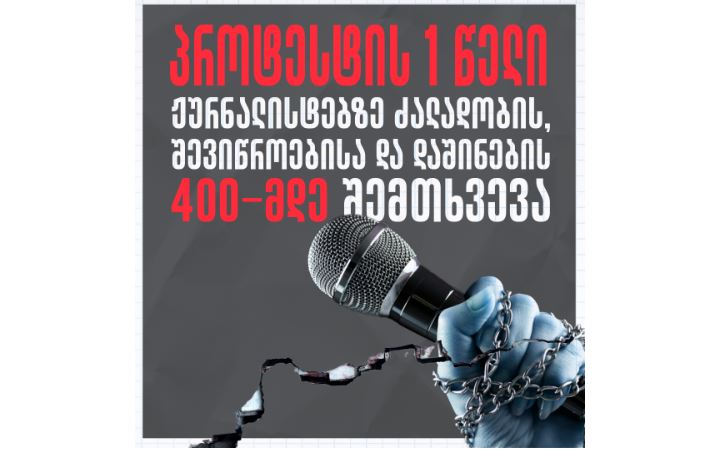


The year-long continuous protest movement, triggered by the ruling party Georgian Dream’s decision on 28 November 2024 to suspend the country’s EU integration process, has been particularly severe for Georgia’s critical media. Operating with already limited financial and technical resources, journalists covered the protests at the cost of significant risks to their safety and health.
Over the course of this one-year protest cycle, nearly 400 publicly documented incidents of violence, intimidation, threats, harassment, persecution, and various forms of interference with the work of independent media and journalists have been recorded. Of these, almost 300 occurred in the past year, and nearly 100 in the final month of 2024 alone.
This document reviews crimes committed against media representatives during protest coverage:
Physical Attacks Against Journalists
Throughout the year-long protest cycle, dozens of journalists and camera operators sustained serious injuries and required medical assistance as a result of targeted physical violence, the use of tear gas spray, and water cannons. Journalists also endured verbal abuse, intimidation, humiliation, and deliberate attempts to discredit them. In numerous cases, their equipment was damaged or confiscated during protest coverage.
Particularly alarming were cases in which journalists and operators broadcasting live were brutally assaulted by so-called “Titushkas,” allegedly organized by the authorities, and by law enforcement officers. For example, in late 2024, TV Pirveli reporter Maka Chikhladze and cameraman Giorgi Shetsiruli were attacked while broadcasting live. In another live broadcast, Formula TV journalist Guram Rogava was hospitalized with severe head injuries after a targeted assault by a special forces officer; he subsequently required a lengthy rehabilitation.
None of the attacks against media personnel have been investigated to date, nor has any perpetrator been held accountable. The evident inaction of law enforcement bodies raises serious concerns that preventing such crimes, ensuring proper investigations, and administering justice are not in the interest of the Georgian Dream government. This fuels well-founded suspicion that these unlawful acts were carried out with the direct involvement or endorsement of the authorities.
Unlawful Detention of Journalists
Over the past year, the unlawful detention of journalists and media workers has become a particularly alarming trend, reaching deeply troubling levels. In the span of one year, 26 media representatives were detained, more than half of them in the final month alone, mostly on administrative charges - primarily the alleged “artificial obstruction of traffic.”
Of particular concern is the criminal detention in January 2025 of Mzia Amaghlobeli, the founder of online outlets Batumelebi and Netgazeti, who was sentenced to two years in prison. Her health significantly deteriorated in custody. According to her rights defenders, her vision has reached a “critical threshold.” The mass detention and persecution of journalists is part of Georgian Dream’s repressive strategy aimed at suppressing and ultimately eliminating free expression in the country.
Unlawful Fines Imposed on Journalists
Another harmful trend observed during the protest cycle has been the imposition of fines on journalists under the pretext of “artificial obstruction of traffic” while performing their professional duties. Over the past year, nearly 40 such cases were documented. The refusal of law enforcement officers to acknowledge journalistic activity during protests, paired with the imposition of substantial fines, serves as a deliberate intimidation tactic, creating additional financial pressure that may ultimately force journalists to abandon their profession.
A Hostile Environment and Legislative Pressure
In addition to the hostile environment faced on the ground, critical media outlets were confronted with legislative and regulatory measures aimed at further restricting their work. These included the expansion of the Communications Commission’s supervisory powers, the use of SLAPP (Strategic Lawsuits Against Public Participation) cases, and the obstruction of funding sources. Due to insufficient financial resources, more than 20 regional broadcasters were unable to resume operations in 2025. In May 2025, Mtavari Arkhi, one of the country’s largest opposition television channels, was forced to shut down. Meanwhile, the ruling party and its affiliated propaganda outlets continued coordinated campaigns to discredit independent media. For instance, on 23 November, the pro-government channel Imedi aired an extensive defamatory piece targeting more than 20 online outlets and investigative journalism networks, labeling them “a propaganda network of foreign intelligence services” and accusing them of inciting unrest and treason.
Despite these challenges, independent and critical media remains steadfast in serving the public and providing reliable information throughout this difficult period. Transparency International Georgia acknowledges the vital role of independent media and expresses deep gratitude to all journalists and media workers for their tireless work and unwavering commitment to professional integrity. Freedom of speech and expression is a fundamental democratic value, guaranteed only by a media landscape free from political influence. Today, independent media in Georgia faces an existential threat. Its destruction would complete the consolidation of a one-party system and place the country firmly on the path toward authoritarian rule.
Georgia: Authorities must repeal new amendments on the Law “On Grants” and other repressive legislation criminalising human rights work